











Why Smart Lighting and Unified Controls Matter More Than Ever in U.S. Data Centers
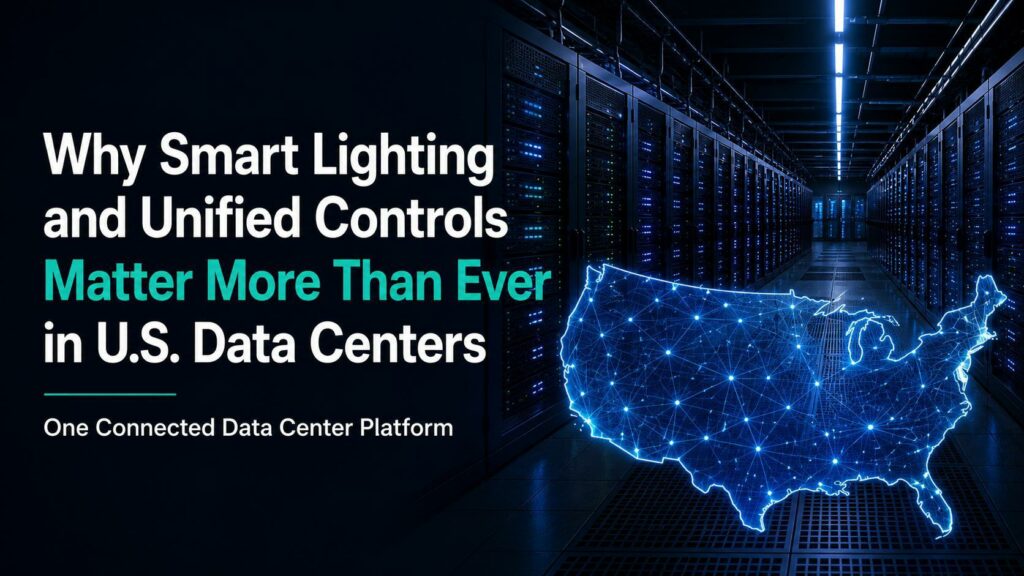
There are now more than 4,500 data centers operating across the United States, consuming roughly 176 terawatt-hours of electricity each year, about 4.4% of the country’s total electricity use. Hundreds more facilities are under construction across 38 states, and according to the U.S. Energy Information Administration, data center electricity demand is expected to continue growing sharply through 2030.
Every megawatt in that story is being fought over. Cooling systems, power distribution, rack density—teams are optimizing all of it because, at this scale, even small percentage gains translate into significant cost savings and valuable grid capacity.
Why Lighting Deserves More Attention
Compared with servers, cooling systems, and power distribution, lighting represents only a small share of a data center’s overall energy use, making it easy to overlook.
But that’s exactly what makes it such an attractive opportunity. Lighting is one of the few building systems that can be almost entirely automated through occupancy sensing, scheduling, centralized controls, and analytics—without disrupting critical IT operations.
Consider a service corridor that’s illuminated around the clock even though technicians may enter only a few times each day. Intelligent lighting controls keep the area safely lit when occupied while reducing unnecessary runtime—and the heat that accompanies it—when it’s empty. The result isn’t just lower lighting energy. It also reduces unnecessary heat, helping cooling systems work more efficiently while improving overall operational visibility.
The Bigger Issue: Too Many Vendors, Not Enough Talking to Each Other
In many facilities, lighting controls, environmental sensors, emergency lighting compliance, asset tracking, and Building Management System (BMS) integration all come from different vendors. Each has its own dashboard, wiring standard, and commissioning process, and very little of that information is shared across systems.
The real cost isn’t just energy. It’s the operational complexity of managing multiple disconnected platforms that should work together.
Lumos Controls addresses that challenge with a unified Data Center Solutions platform. Built on a low-voltage 48VDC architecture, it combines intelligent lighting, environmental sensing, real-time tracking, emergency lighting management, analytics, and BMS integration into a single ecosystem. The platform can be deployed in the cloud or fully on-premises through the Iris S edge server, giving organizations the flexibility to meet their cybersecurity, data sovereignty, and IT governance requirements while maintaining centralized control of building operations.
What the Platform Delivers
• Supporting better PUE by relocating AC-to-DC conversion away from the white space, reducing fixture heat where cooling demand is highest.
• Security and access awareness with real-time visibility of personnel and assets.
• A unified platform for lighting, sensing, tracking, analytics, and controls.
• Operational visibility through centralized dashboards and remote management.
• Compliance and resilience with automated emergency lighting testing, reporting, and scheduling.
• Cloud or on-premises deployment, allowing organizations to choose the security model that best fits their operations.
How It Works
- Lighting Automation
Cyrus F, Cyrus AP, and Cyrus AM sensors automate lighting in data halls, corridors, and support spaces. Occupancy sensing ensures lights dim or switch off when areas are vacant and return instantly when someone enters
- Environmental Monitoring
The Cyrus AQ sensor continuously measures temperature, humidity, CO₂, particulate matter, VOCs, and overall indoor air quality, giving facility teams real-time insight into conditions that affect equipment reliability.
- Asset & Personnel Tracking
A BLE-based network of tags, listeners, gateways, and range extenders (TRAK) provides real-time visibility into equipment, tools, and personnel across the facility.
- Emergency Lighting & Unified Management
Automated emergency lighting testing, activation, failover, and reporting are handled centrally instead of through manual inspections. The Enor E gateway connects all devices to a single web and mobile platform for scheduling, monitoring, analytics, and remote control.
- Why the Low-Voltage Foundation Matters
The 48VDC architecture is more than a technical specification. It aligns with the direction many modern data centers are taking to reduce unnecessary AC-to-DC conversion losses. By applying the same approach to the controls layer, Lumos Controls keeps heat-producing components out of the white space, contributing in a small but meaningful way to improved facility efficiency and supporting better PUE.
- Supporting Energy Code Compliance
While data centers have unique operating requirements, lighting systems are still expected to meet applicable energy efficiency requirements in many jurisdictions. Intelligent lighting controls including occupancy sensing, scheduling, and centralized monitoring can help support compliance with energy codes such as ASHRAE 90.1 and the International Energy Conservation Code (IECC), where applicable. By automating lighting operation and providing centralized control and reporting, facilities can improve energy management while simplifying ongoing operations.
- The Takeaway
None of this replaces the larger efficiency levers—cooling design and power distribution will always have the biggest impact. But as U.S. data center capacity continues to expand and power becomes an increasingly constrained resource, every controllable load deserves attention.
Lighting may account for only a small fraction of total energy consumption, yet it’s one of the few building systems that can be almost entirely automated. When combined with environmental monitoring, asset tracking, emergency lighting management, and BMS integration on a single platform, those incremental gains become operational advantages that extend well beyond the utility bill.
Sometimes the biggest improvement in a data center isn’t deploying another complex technology. It’s connecting the systems you already rely on and ensuring they work together intelligently.