











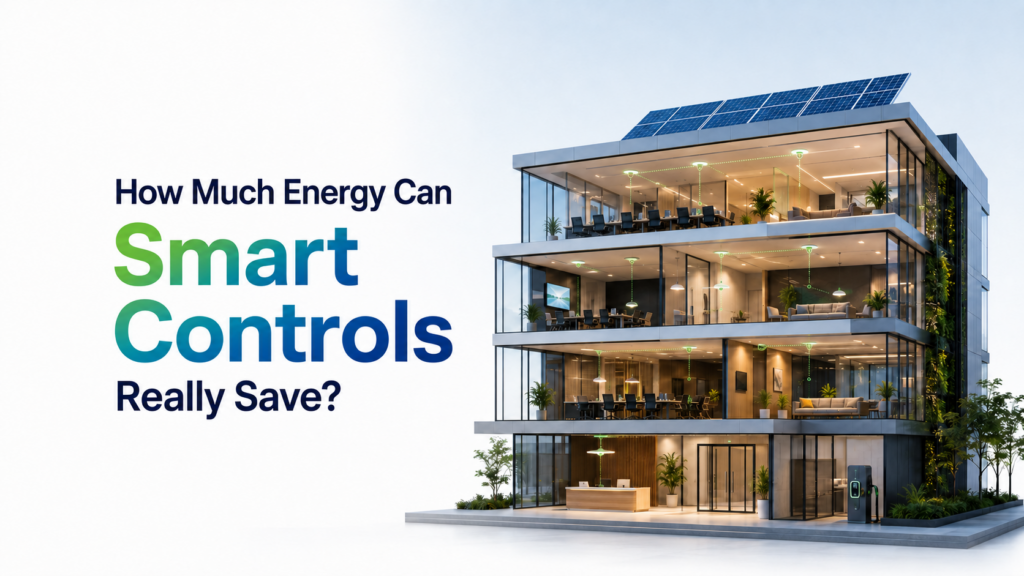
How Much Energy Can Smart Controls Really Save?
What the Research Says
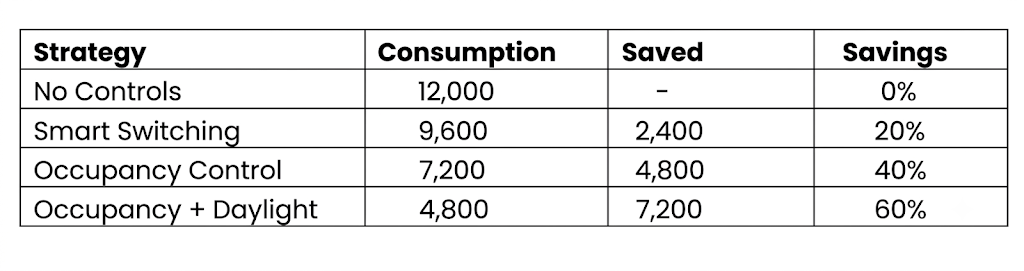
LBNL examined 240 energy-saving estimates from 88 studies and case studies involving lighting controls in commercial buildings. The analysis established the following average lighting energy-saving potential:
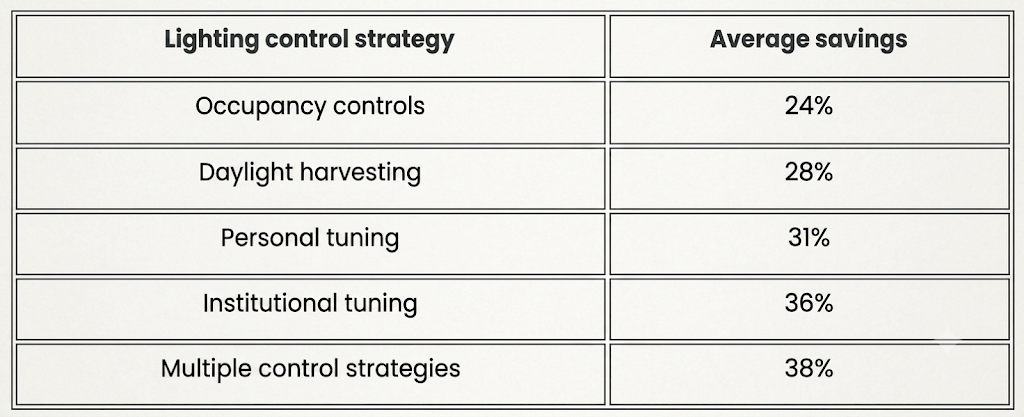
The findings demonstrate an important point: individual strategies can make a meaningful difference, but combining multiple control methods generally creates the greatest savings opportunity. LBNL Meta-Analysis
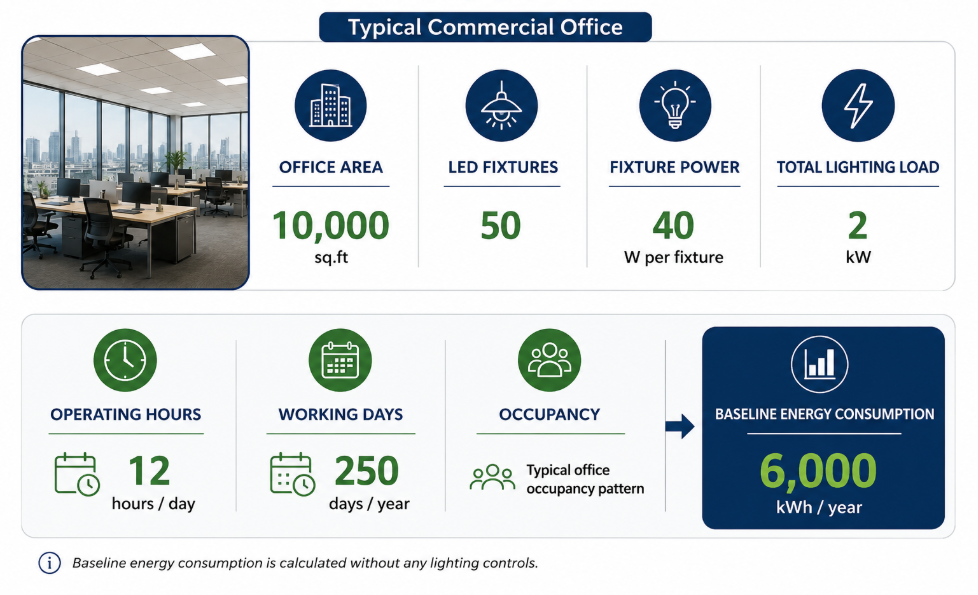
Consider a medium-sized commercial office with 50 LED fixtures (40 W each), operating 12 hours/day for 250 working days per year.
Option 1 – Smart Switching, Scheduling & Dimming
Lighting Control Features:
• Smart switches
• Mobile/Web app control
• Scheduling
• High-end trim
• Manual dimming
• Scene control
How It Saves Energy
Lighting can be switched off remotely, scheduled to operate only during business hours, and dimmed when full brightness is not required. High-End Trim further reduces energy by limiting maximum fixture output to the required illumination level.
Typical Savings: 20%
Example:
Baseline: 12,000 kWh/year
Consumption after controls: 9,600 kWh/year
Energy Saved: 2,400 kWh/year
Option 2 – Occupancy-Based Lighting Control
Includes all Option 1 features plus:
• PIR occupancy sensors
• Automatic ON/OFF
• Vacancy timeout
• Configurable occupied/unoccupied light levels
How It Saves Energy
Lighting automatically turns ON when a space is occupied and OFF or dims after it becomes vacant, eliminating unnecessary lighting operation in meeting rooms, cabins, corridors, and other intermittently occupied spaces.
Typical Savings: 40%
Example:
Consumption: 7,200 kWh/year
Energy Saved: 4,800 kWh/year
Option 3 – Occupancy + Daylight Harvesting
Includes all Option 2 features plus:
• Daylight sensors
• Automatic daylight harvesting
Control Logic:
• No occupancy → Lights OFF.
• Occupancy + sufficient daylight → Lights remain OFF or dim to minimum.
• Occupancy + partial daylight → Lights provide only the additional illumination required.
• Occupancy + little/no daylight → Lights operate at the required brightness.
How It Saves Energy
Lighting output continuously adjusts based on both occupancy and available natural daylight, ensuring only the required amount of artificial lighting is used throughout the day.
Typical Savings: 60%
Example:
Consumption: 4,800 kWh/year
Energy Saved: 7,200 kWh/year
Extending Energy Optimization to HVAC
Lighting is only one part of a building’s energy consumption. Smart controls can also coordinate HVAC operation with actual space usage.
HVAC-control strategies can include:
- Occupancy-based temperature control
- Automated occupied and unoccupied setpoints
- Time-based HVAC scheduling
- After-hours overrides
- Zone-level temperature management
- Integration with room occupancy sensors
- Centralized monitoring and control
When a room becomes vacant, the system can turn off or dim the lighting while simultaneously adjusting the HVAC setpoint. This prevents spaces from being fully illuminated, heated or cooled when they are not in use.
Actual HVAC savings depend on climate, equipment efficiency, building envelope, operating schedules, setpoints and occupancy patterns.
Supporting Grid Responsiveness with OpenADR
OpenADR enables buildings to participate in automated demand-response programs by receiving signals from utilities or energy-service providers.
During periods of high grid demand, a smart control system can temporarily implement predefined energy-reduction strategies, such as:
- Reducing lighting output within acceptable limits
- Adjusting HVAC temperature setpoints
- Limiting selected noncritical loads
- Rescheduling flexible building operations
- Restoring normal settings automatically after the event
OpenADR is primarily a demand-management and grid-flexibility capability. Its benefits can include reduced peak demand, improved participation in utility programs and better coordination between building systems and the electrical grid.
Managing Plug Loads
Plug loads – including computers, monitors, printers, chargers, kitchen equipment and other connected devices—can continue consuming energy even when spaces are unoccupied.
Smart controls can help manage these loads through:
- Occupancy-based receptacle control
- Scheduled ON/OFF operation
- Automatic shutdown after working hours
- Remote monitoring and control
- Control of selected noncritical outlets
- Coordination with lighting and HVAC occupancy modes
When a space becomes vacant, the system can switch off or reduce selected plug loads alongside the lighting and HVAC systems. Essential equipment can remain continuously powered, while noncritical devices are automatically controlled to reduce unnecessary energy consumption and standby power.
Actual savings depend on the connected equipment, operating schedules, occupancy patterns and the receptacles selected for automatic control.
Energy Savings Comparison
Customer Insight: Approximately 50% Energy Savings
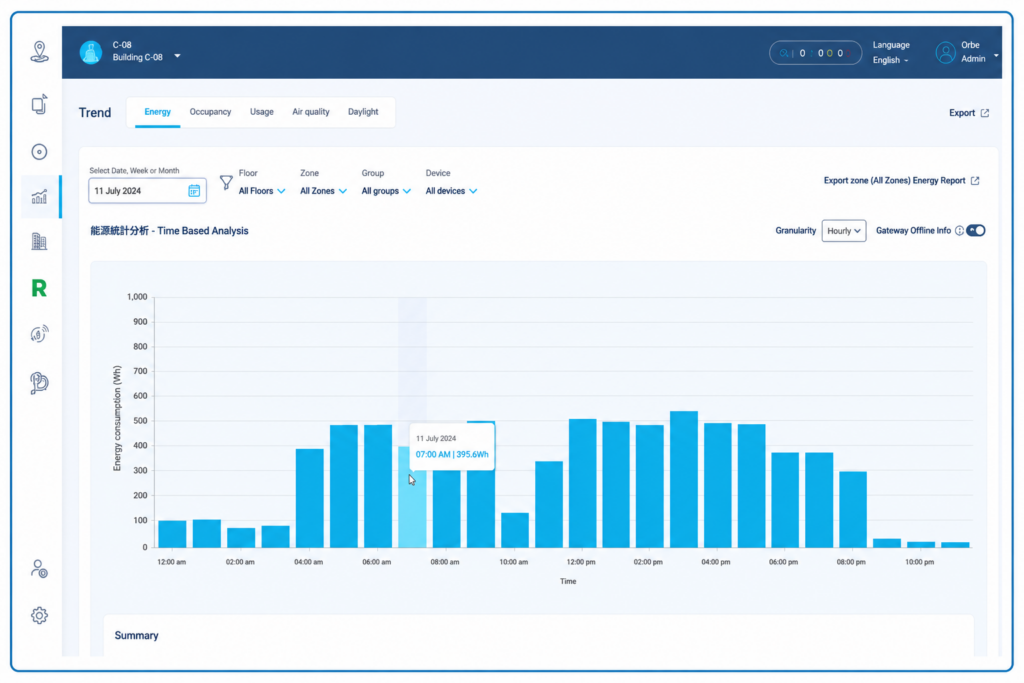
In this account, the total maximum power rating of all lighting devices is 991 W. Therefore, the maximum energy the lighting system can consume in one hour, when all lights are operating at full output, is approximately 991 Wh (0.991 kWh).
This account is configured with both daylight harvesting and motion-based automation. As shown in the attached video, the daily energy consumption indicates that the automation is achieving approximately 50% energy savings compared to operating all lights continuously at full power.
A Connected Approach to Energy Optimization
Smart controls provide a scalable path toward whole-building energy optimization.
Organizations can begin with smart lighting, scheduling and high-end trim, then introduce occupancy sensing, daylight harvesting, HVAC coordination and plug-load control. OpenADR can further extend the system by enabling an automated response to grid and utility signals.
By coordinating lighting, HVAC, plug loads and demand-response strategies, buildings can reduce unnecessary energy use, manage peak demand and create more comfortable, responsive environments.