


Cloud or On-Premises? Choosing the Right Building Control Deployment
Choose a deployment approach that fits your building’s operational needs, connectivity requirements and data management priorities.
A facility manager wants to monitor several buildings from one dashboard. The IT team wants to know where operational data will be stored. The maintenance team needs reliable access to building controls.
These requirements all influence one decision: should your building control platform run in the cloud or on-premises?
Both approaches can support intelligent building operations. The right choice depends on how your organization manages infrastructure, information and day-to-day responsibilities.
What Is the Difference?
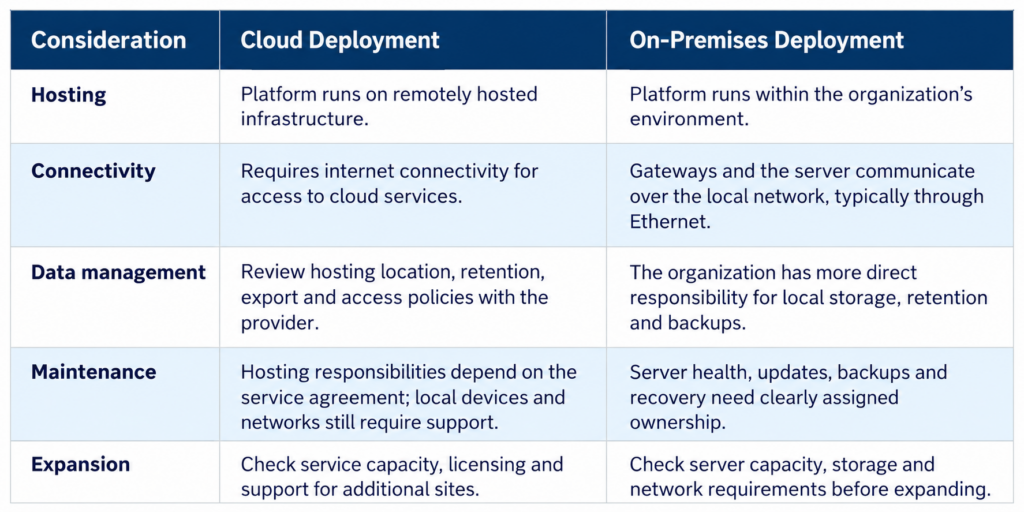
In a cloud deployment, the management platform runs on remotely hosted infrastructure. A gateway connects the building’s device network to the cloud through an internet connection, allowing authorized users to monitor and manage the system remotely.
In an on-premises deployment, the management platform runs on a server within the organization’s own environment. Gateways and the server communicate over the local network, typically through Ethernet, while users access the platform locally or through an approved remote-access connection.
Ethernet provides a wired network connection; it does not necessarily require internet access.
Cloud and On-Premises at a Glance
1. Align Deployment with Your Building’s Requirements
Different facilities have different priorities for connectivity, data security and system management.
In data centers, banks and warehouses handling sensitive operational information, internal policies may require building data to remain within the organization’s network. An on-premises deployment can support these requirements by keeping the management platform and its data within the organization’s environment.
For organizations managing multiple offices, retail outlets or geographically distributed facilities, cloud deployment can simplify centralized monitoring and remote access.
Involve both facility and IT teams early to confirm where data can be stored, who needs access and who will maintain the system. Data security depends on access controls, configuration and ongoing maintenance in either deployment.
2. Decide Who Needs Access—and from Where
Think about the people who will use the system.
Will a facility manager work primarily inside one building? Will a central team oversee several locations? Will an external service partner need occasional access?
Cloud deployment can be a practical fit for distributed operations. On-premises deployment may suit organizations that prefer management access to remain within their network.
On-premises systems can also support remote access through an approved connection. The access method, permissions and support process should be agreed with IT.
For either approach, define who can view information, change settings and administer the system.
3. Understand the Data You Are Managing
Building platforms can collect device status, energy consumption, environmental readings and occupancy information. Where location intelligence is included, asset or personnel location information may require additional attention.
Before selecting a deployment model, ask:
- What information will the platform collect?
- Where will the primary data and backup copies be stored?
- Who can access or export that information?
- How long should records be retained?
- What happens to the data when a service agreement ends?
Cloud hosting should be evaluated against the provider’s documented arrangements. On-premises hosting requires the organization to establish and maintain its own procedures.
The location of a server alone does not determine how well information is protected. Access controls, maintenance practices and recovery procedures also matter.
Deployment Flexibility with Lumos Controls
Lumos Controls offers cloud and on-premises deployment options. Iris S, its on-premises server solution, supports local lighting control, sensor automation, scheduling, reporting, smart emergency lighting testing and BMS integration without relying on external servers.
Choose cloud when centralized remote access and reduced local hosting responsibilities are priorities. Choose on-premises when internal hosting policies and direct control over infrastructure and data are key requirements.
Connect with Lumos Controls to find the right deployment for your building.

