


Lighting Meets HVAC:What’s Changing for Connected Buildings in 2026
Why shared occupancy information is becoming an important link between lighting controls and HVAC operation.
A meeting ends early. The room empties. An occupancy sensor switches off the lights—but the heating and cooling continue following the day’s schedule.
When lighting and HVAC share occupancy information, the building can respond more closely to how spaces are actually used.
California’s 2025 Energy Code and the DesignLights Consortium’s August 2026 NLC V5.2 update bring this connection into focus. They serve different purposes, but both highlight the value of coordinating building systems.
What California’s 2025 Energy Code Requires
California’s 2025 Building Energy Efficiency Standards apply to permit applications submitted on or after January 1, 2026. For relevant projects, occupancy-based HVAC control forms part of the compliance requirements. energy.ca.gov
The code includes occupied-standby controls for qualifying zones. This means a space can move into a reduced operating mode when it becomes vacant during scheduled occupied hours.
Applicability depends on conditions including the lighting occupancy-sensor requirements, whether every room in the zone is permitted to reduce ventilation to zero, and the control system involved. Where applicable, the controls coordinate ventilation changes and temperature-setpoint adjustments. energy.ca.gov
This is not a blanket instruction to switch off every HVAC system whenever someone leaves a room. The response must suit the zone, equipment and applicable requirements.
Occupancy-based HVAC control also predates the 2025 edition. The practical message is to evaluate the current requirements early, rather than treating lighting and mechanical controls as unrelated decisions. efiling.energy.ca.gov
What DLC’s August Update Adds
The DesignLights Consortium’s Networked Lighting Controls Technical Requirements Version 5.2, effective August 17, 2026, expands recognition of lighting-to-HVAC integration through thermostats. It also strengthens standardized system configuration reporting. DesignLights
The opportunity is straightforward: occupancy information collected by lighting sensors can be shared with compatible thermostats, allowing HVAC operation to respond when spaces are unoccupied. DLC identifies this as particularly useful for small and medium-sized commercial buildings. DesignLights
DLC qualification and California code compliance are different. California establishes regulatory requirements for applicable projects. DLC provides a framework for identifying and comparing qualified lighting control systems.
A DLC listing should therefore be reviewed for the specific capabilities a project needs. It does not, by itself, establish HVAC compatibility or compliance with California’s Energy Code. DLC also states that it does not qualify the HVAC-specific capabilities of integrated building management systems. DesignLights
How Shared Occupancy Information Works
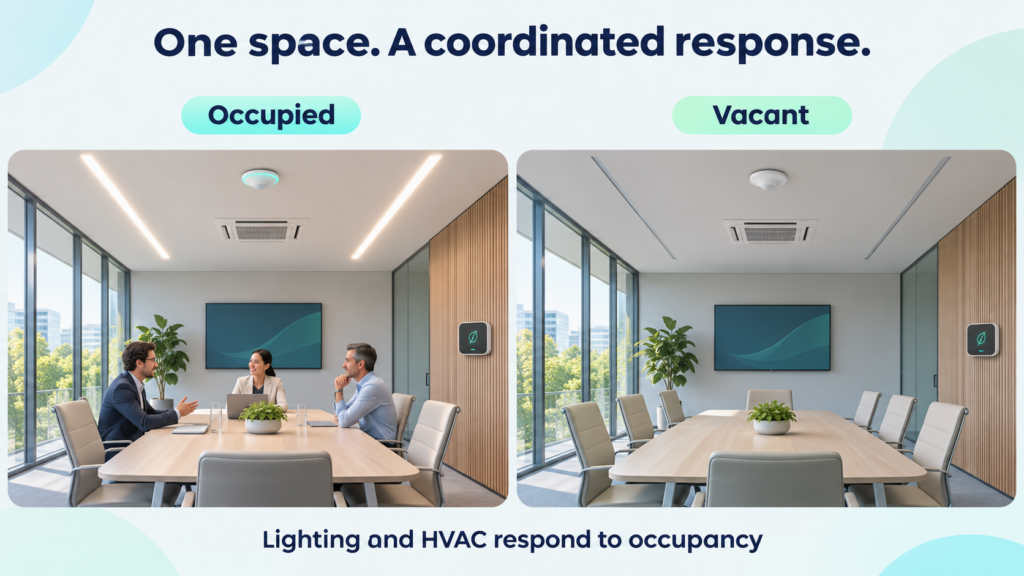
Consider a conference room with compatible lighting and HVAC controls:
- People enter: Sensors detect occupancy, and each system follows its configured occupied sequence.
- The room becomes vacant: After the appropriate delay, lighting responds and HVAC moves to its configured standby settings.
- People return: The systems resume the appropriate occupied operation.
The systems can share occupancy information while retaining different response timings and control rules.
For example, switching lights off manually does not necessarily mean the room is empty. California’s provisions require the ventilation signal from shared lighting sensors to remain independent of daylighting and manual lighting controls. When several rooms share one HVAC zone, all must be vacant before the zone is treated as vacant. energy.ca.gov
How Lumos Controls Supports Lighting and HVAC Coordination
Lumos Controls brings occupancy sensors, lighting and compatible HVAC equipment together through its HVAC Gateway and Control Panel. With appropriate configuration and commissioning, this coordinated approach helps spaces respond to actual use and supports project-specific energy control requirements.
Connect with Lumos Controls to explore coordinated lighting, HVAC and sensor controls for your project.

