


Low-Voltage vs. Line-Voltage Lighting Sensors: Which Should You Choose?
Choose the right sensor for your power supply, fixture design and lighting control needs.
Choosing a lighting sensor starts with understanding how it will be powered and what it needs to control. Low-voltage and line-voltage sensors can both support lighting automation, but their installation requirements differ.
This guide explains the differences and helps you select the right Lumos Controls sensor for your project.
What Is the Difference?
Low-voltage sensors operate from a DC supply. They receive power from a compatible source, such as an LED driver’s auxiliary output or a separate DC power supply. Lumos Controls Cyrus F, for example, operates on 12–24VDC.
Line-voltage sensors receive power directly from an AC supply within their specified voltage range. Lumos Controls Cyrus AP and Cyrus AM, for example, operate on 90–277VAC.
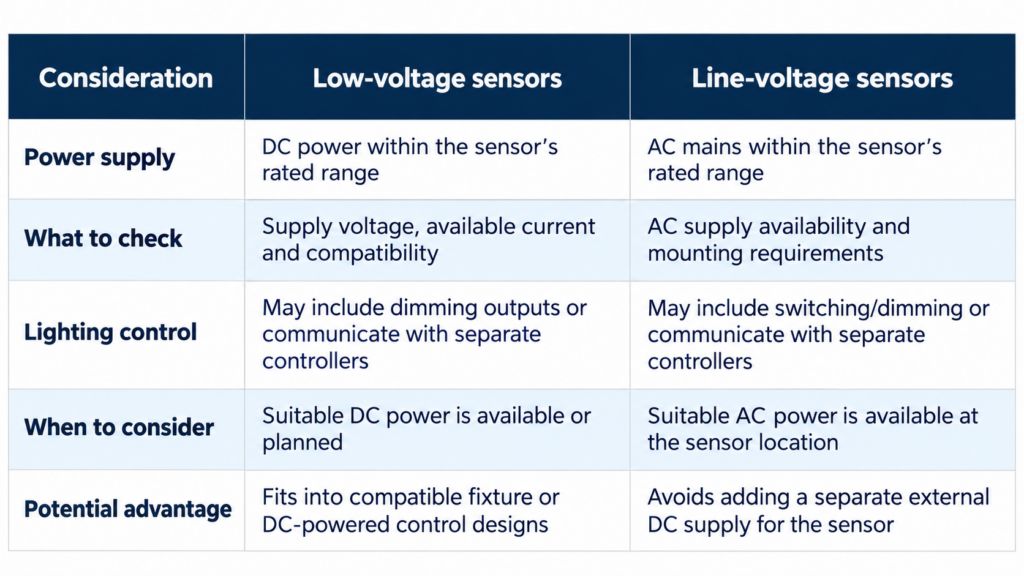
Low-Voltage and Line-Voltage Sensors at a Glance
When and Why Should You Choose Low-Voltage Sensors?
Choose a low-voltage sensor when your fixture or lighting system already provides a compatible DC supply, or when DC power is part of the planned installation.
For example, Cyrus F combines PIR motion detection, ambient light sensing and dual-channel 0–10V outputs for brightness and correlated color temperature (CCT) control. Its compact fixture-mounted design makes it a practical option for integrating sensing and control into compatible luminaires.
Low-voltage options also include ceiling-mounted devices. The PSC-BL-D-CM-DC-BLE-WS uses 12–24VDC and combines PIR and ultrasonic occupancy detection.
Why choose low voltage? It can make use of an existing compatible DC supply and suit the intended fixture or control design. Confirm that the supply provides enough current and that the sensor’s outputs match the driver or controller.
When and Why Should You Choose Line-Voltage Sensors?
Choose a line-voltage sensor when suitable AC power is available at the intended installation point and a separate DC supply would add unnecessary equipment or wiring.
Cyrus AP provides PIR motion and daylight sensing, with ceiling or surface mounting and interchangeable lenses for different mounting applications. Cyrus AM provides microwave motion and daylight sensing. Both operate from AC power.
Why choose line voltage? It can simplify sensor power provision where mains wiring is already available. However, check the complete control arrangement: Cyrus AP, for example, works with associated controllers rather than directly switching the lighting load.
What Should You Choose for Your Project?
These are starting points for selection. The final choice should account for the complete installation, including power, mounting, sensing coverage and lighting control compatibility.
Match the Sensor to the Installation
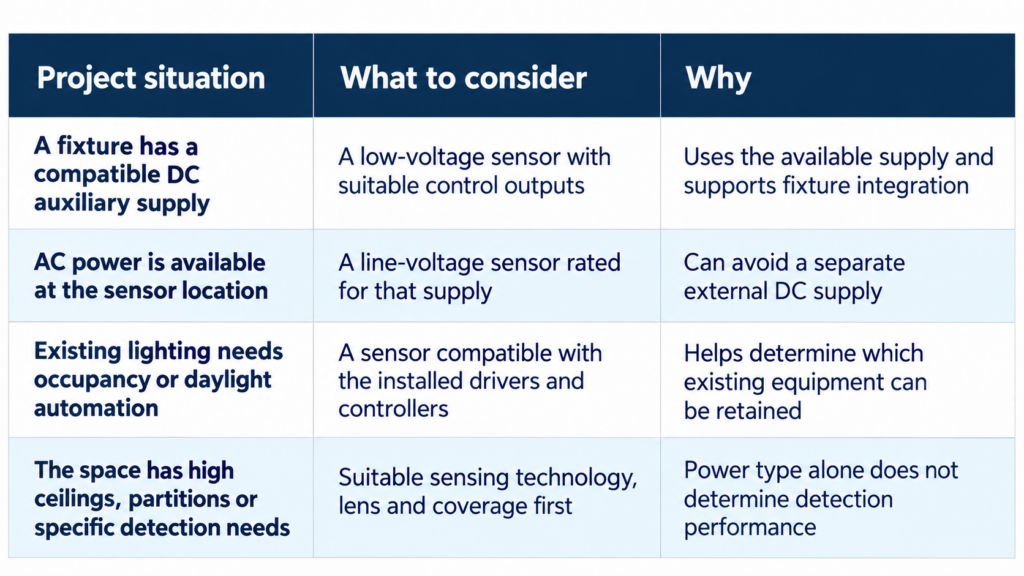
Choose low voltage when compatible DC power fits your design. Choose line voltage when available AC power makes it the practical option. In either case, confirm that the sensor provides the detection coverage and control functions your space needs.
Connect with Lumos Controls to find the right sensor for your next lighting project.

