












Vacancy Sensing vs Occupancy Sensing: Which Lighting Control Solution is Right for Your Space?
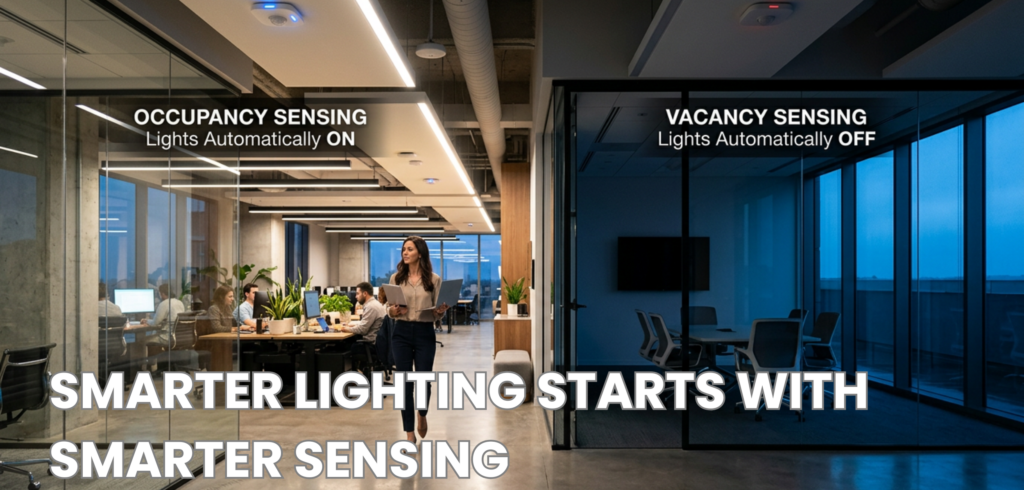
What if your lighting system could automatically respond to how people use a space?
What if lights could switch on only when needed, reduce energy waste, and create a more efficient environment without constant manual control?
This is exactly why intelligent sensing technologies are becoming an essential part of modern lighting control systems. Among the most widely used solutions are occupancy sensing and vacancy sensing. While both are designed to improve energy efficiency and user convenience, they operate differently and are suited for different applications.
Understanding the difference between these two technologies can help businesses, facility managers, and designers choose the right solution for smarter and more sustainable spaces.
What is Occupancy Sensing?
Lighting That Automatically Turns On and Off
Occupancy sensing automatically turns the lights ON when motion or presence is detected within a space and switches them OFF after the area becomes vacant for a preset period of time.
This hands free operation makes occupancy sensing ideal for spaces where convenience, automation, and energy savings are priorities.
Using technologies such as PIR Motion Detection, Microwave Sensing, or Dual-Tech Sensing Systems, occupancy sensors continuously monitor room activity and respond instantly when someone enters or exits.
Benefits of Occupancy Sensing
- Completely automated lighting control
- Reduces unnecessary energy consumption
- Enhances user convenience
- Improves operational efficiency
- Ideal for high traffic or frequently occupied spaces
Best Applications

What is Vacancy Sensing?
Intelligent Energy Savings with Manual ON Control
Vacancy sensing works slightly differently. In this mode, users manually switch the lights ON when entering a space, while the sensor automatically turns the lights OFF when the room becomes unoccupied.
This approach provides greater control to occupants while still delivering substantial energy savings. Since lights do not automatically turn on with every movement, vacancy sensing helps prevent unnecessary lighting activation during brief or unintended occupancy.
Benefits of Vacancy Sensing
- Greater user control over lighting
- Prevents accidental lighting activation
- Maximizes energy savings
- Supports energy code compliance
- Ideal for intermittently used spaces
Best Applications

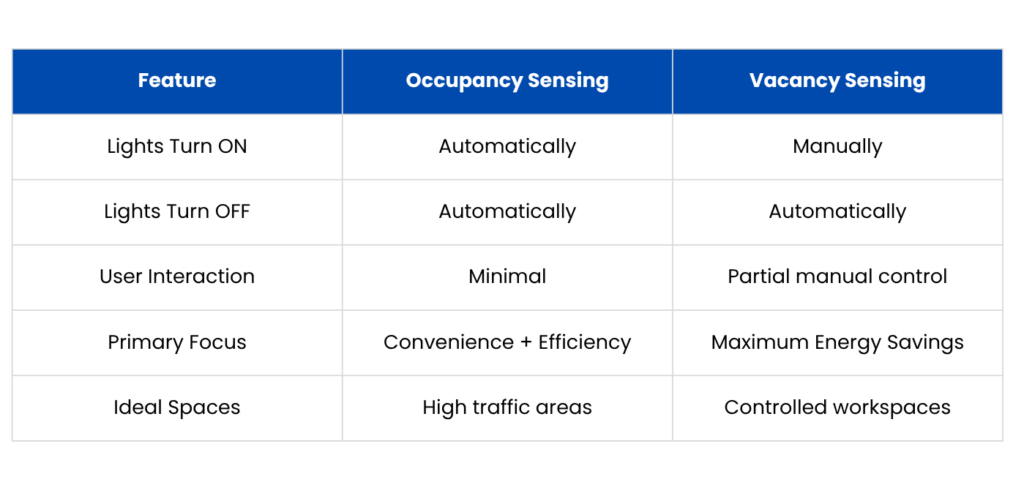
Occupancy vs Vacancy Sensing:
What is the Difference?
Which Solution is Best for Your Space?
The right choice depends on how the space is used.
If convenience and fully automated operation are important, occupancy sensing is the ideal solution. However, if reducing unnecessary lighting usage and maximizing energy efficiency are the priority, vacancy sensing offers greater control and savings.
Many modern smart buildings combine both strategies across different areas to optimize comfort, efficiency, and sustainability.
Intelligent Sensing for Smarter Buildings
As buildings become more connected and energy conscious, sensing technologies are playing a critical role in lighting automation strategies. Intelligent occupancy and vacancy sensing not only reduce operational costs but also contribute to more sustainable and user friendly environments.
With advanced sensing solutions, businesses can create lighting systems that respond intelligently to real world usage while enhancing occupant comfort and improving overall building performance.
Ready to make your lighting smarter?
Discover intelligent sensing solutions from Lumos that help create more efficient, automated, and energy conscious spaces.