







D4i Explained: What Makes It Different from DALI-2?
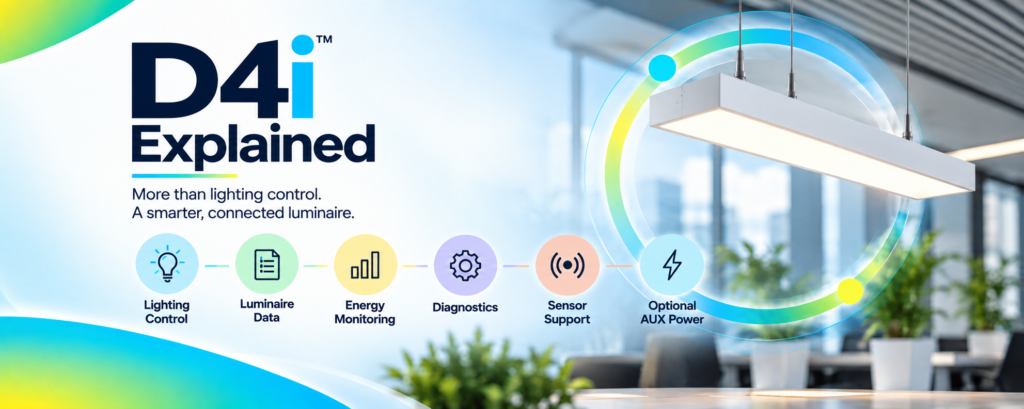
DALI-2 already gives us standardized digital lighting control. We can switch, dim, recall scenes, control color temperature, and connect compatible sensors and switches.
So why do we need D4i?
The simplest answer is:
DALI-2 focuses on standardized lighting control. D4i extends DALI-2 with a defined set of features for intelligent, data-rich, IoT-ready luminaires.
In fact, D4i is not a replacement for DALI-2. D4i-certified drivers and control devices are also DALI-2 certified.
So, What Exactly Is D4i?
D4i is a DALI Alliance certification that extends DALI-2 for intelligent, connected luminaires. It enables a D4i driver, sensors, and control devices to work together at the individual luminaire level, while also making standardized luminaire, energy, and diagnostic data available to the control system.
A D4i LED driver can do the normal job of a DALI-2 LED driver, but it also has additional standardized capabilities for power and data.
Think of it this way:
DALI-2:
Control the luminaire.
D4i:
Control the luminaire + power compatible control devices + provide standardized luminaire data.
When should you actually opt for D4i?
Buy D4i when your project needs things like:
Sensor inside the luminaire
You want a motion/daylight sensor or wireless controller attached to the fixture without a separate power supply.
Per-luminaire diagnostics
You want operating hours, failure information, temperature-related data, or other maintenance information.
Asset management
You want each luminaire to provide standardized identification/specification data.
Connected-building integration
You want a wireless controller to pull D4i data from the driver and send it to a larger network.
What’s Inside a D4i Driver?
This is where the difference becomes much clearer.
For a D4i LED driver, several additional features are mandatory.
1. Integrated DALI Bus Power Supply — Part 250
A D4i driver has an integrated bus power supply. This allows compatible sensors or control devices to receive power from the DALI bus, simplifying the addition of controls at the luminaire.
2. Luminaire Data — Part 251
The driver can store standardized information about the luminaire, such as light output, CCT, CRI and other luminaire characteristics. This can support asset identification, commissioning and lighting asset management.
3. Energy Data — Part 252
The driver can provide energy and power information, enabling energy monitoring closer to the individual luminaire level.
4. Diagnostics & Maintenance Data — Part 253
The driver can provide operational and diagnostic information, including supported data related to operating time, failures, temperature, supply conditions and light-source operation.
An AUX 24 V supply (Part 150) can also be provided for devices that require more power, but this is optional for D4i driver certification.
Where Do Sensors and Wireless Controls Fit?
This is another important part of D4i.
A luminaire can include or connect to compatible occupancy sensors, light sensors or wireless communication/control devices.
The D4i driver supplies the DALI communication interface and bus power, while a control device can provide sensing, intelligence or connectivity to a larger wireless network.
So you can think of the architecture as:
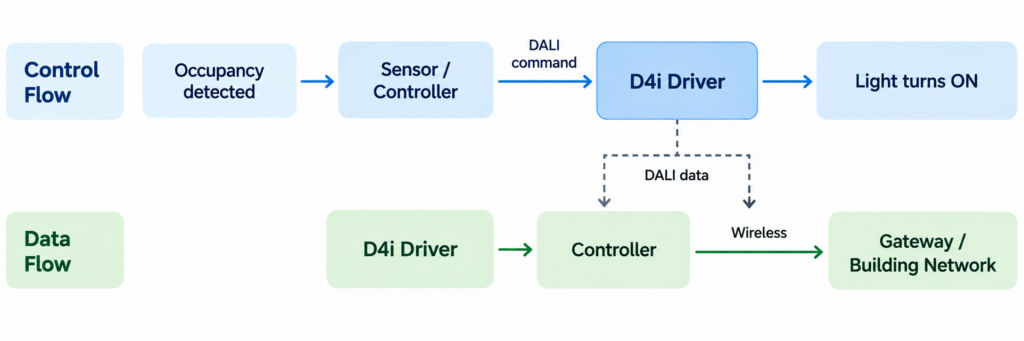
Now an individual luminaire can become a connected point within the building rather than simply a controllable light.
Where Lumos Controls Fits
This is where solutions such as Lumos Controls Radiar ZD and Cyrus MD1 become relevant.
Radiar ZD can bring D4i lighting into the Lumos Controls wireless ecosystem, connecting luminaire-level control with the broader building network.
Cyrus MD1 combines DALI control with microwave motion and daylight sensing, allowing the luminaire to respond to occupancy and available natural light.
The result is a progression from:
Control the light
to
Control + Sense + Collect Data + Connect
And that is really what D4i is about: making the luminaire a more useful part of the connected building.