












Smart Lighting Controls with Partition Sensing for a Full-Service Hotel in Indianapolis
Background
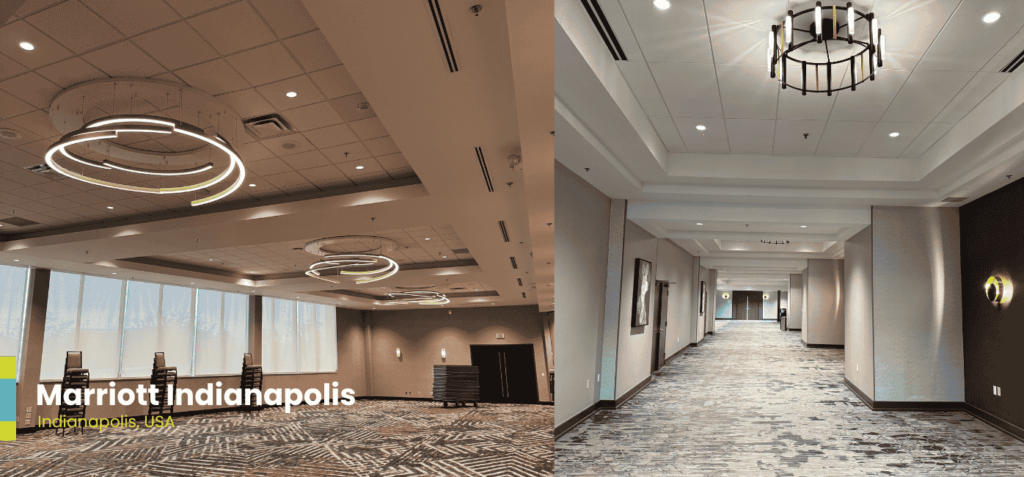
Indianapolis has built a reputation as one of America’s busiest convention cities, and for its full-service hotels, the event floor is where business is won or lost. This Marriott property is built for exactly that kind of work, with a large divisible ballroom, additional function rooms, wide pre-function corridors, and a bright lobby bar and dining area sitting beneath a grid of skylights and a full wall of glazing.
What the hotel needed was a lighting control approach that could keep up with spaces that change shape and purpose from one booking to the next. Lumos Controls worked directly with the project team to design a wireless system covering the event floor and public areas, with every device pre-commissioned by our dedicated team before it reached the site.
Objectives
- Match lighting behaviour to ballroom partition layouts as airwalls open and close
- Bring decorative and architectural fixtures with different dimming methods onto one wireless network
- Give banquet staff fast, dependable scene control at the point of use
- Apply occupancy and daylight strategies across public and circulation areas
- Keep on-site commissioning time to a minimum in a working hotel
Challenges:
A hotel ballroom rarely stays one room for long. On a single day, the main ballroom at this property might open as one large hall for a morning general session, split into separate salons for afternoon breakouts, then recombine for an evening reception. Every time an airwall moves, the definition of the room changes, and the lighting is expected to follow.
Traditionally that has meant one of two things. Either banquet staff walk the floor adjusting lights section by section at every changeover, or the property invests in wired partition interfaces that add cost and complexity to the build. Neither option suited a hotel that turns its spaces around several times a day on tight event schedules.
The load mix brought its own complication. Decorative drum chandeliers, ring pendants, and sconces across the event floor run on phase dimming, while recessed downlights and architectural lighting operate on 0-10V. These different dimming methods needed to respond together inside a single scene, so a banquet captain pressing one button gets a coordinated result across every fixture type in the room. Out in the lobby and dining areas, generous daylight from skylights and floor-to-ceiling windows meant electric lighting had to work with natural light rather than compete against it.
Solutions
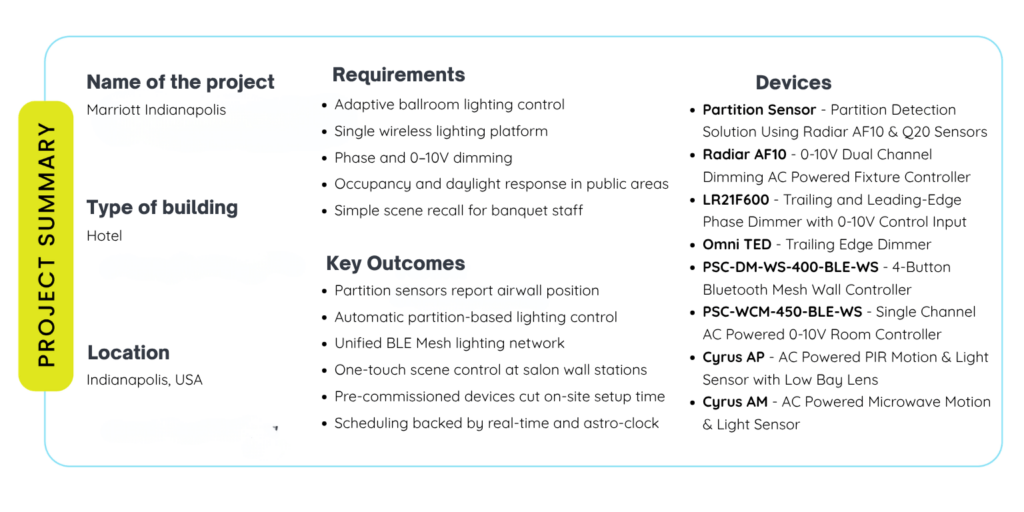
Partition detection solution using Radiar AF10 & Q20 sensors – Partition Sensor
Across each airwall track in the divisible ballroom, a Banner Q20EL infrared emitter and Q20PRL receiver form a precise optical sensing barrier. The moment a partition moves and interrupts the beam, the receiver sends a signal to the Radiar AF10 through its 0-10V sensor input, and the controller passes that state change to the Lumos Controls network, which then triggers the lighting configuration that matches the new layout. The Q20 housings are compact and overmolded for durability, with integral threaded mounting holes that made fitting them along the partition tracks straightforward. The result is a ballroom where the control system always knows whether it is one room or several, without anyone having to tell it.
Wireless 0-10V dual channel dimming AC powered fixture controller – Radiar AF10
Beyond its role in partition detection, the Radiar AF10 does much of the everyday work in this building. Fitted at fixtures and junction boxes across the ballroom, function rooms, and pre-function corridors, it gives each 0-10V luminaire group its own wireless control point on the BLE mesh. Its dual output channels handle intensity control, while the built-in relay manages switching, and its sensor input is what allows the Q20 receivers to speak to the network in the first place.
Trailing and leading-edge phase dimmer with 0-10V control input – LR21F600
The decorative chandeliers and pendants run on phase dimming, which most wireless platforms can’t address directly. The LR21F600 closed that gap. Paired with the Radiar AF10, it delivers smooth trailing or leading-edge dimming to the statement chandeliers in the ballroom and corridors while taking its instructions from the Lumos Controls BLE network. Fixtures that would otherwise have needed separate dimming infrastructure now sit inside the same scenes as everything else.
Trailing edge dimmer – Omni TED
Smaller decorative loads received the same treatment through the Omni TED. Wall sconces along the pre-function corridors and within the salons dim through this compact trailing edge dimmer, which tucks neatly behind fixtures and brings each load onto the network. Guests experience one continuous quality of light from the corridor sconce to the ballroom chandelier, even though the hardware behind them differs.
4-button wireless Bluetooth mesh wall controller – PSC-DM-WS-400-BLE-WS
Event staff still need control they can put their hands on. Four-button wireless wall controllers sit at the service entries of each salon, letting a banquet captain recall preset scenes for setup, dining, presentation, or teardown in a single press. Because the controllers communicate over the mesh rather than through wiring, they were positioned where staff actually work rather than where conduit happened to run.
Single channel AC powered 0-10V room controller – PSC-WCM-450-BLE-WS
In the hotel meeting rooms, a lighter touch was appropriate. A single PSC-WCM-450-BLE-WS room controller manages each space, switching and dimming the room lighting as one zone through its 0-10V output and high-capacity relay. It keeps the smaller rooms simple to operate and simple to maintain while remaining fully part of the wider network.
AC powered PIR motion & light sensor with low bay lens – Cyrus AP
Public and circulation spaces run largely on their own. Cyrus AP sensors, surface mounted with low bay lenses suited to the ceiling heights, watch over pre-function corridors and support areas, holding lights at the right level when people are present and easing them down when spaces empty out. In the daylight-rich lobby and dining areas, the same sensors read available natural light so the electric lighting contributes only what the skylights and windows cannot.
AC powered microwave motion & light sensor – Cyrus AM
Where ceilings rise higher and detection needs stretch further, surface-mounted Cyrus AM sensors take over. Their microwave sensing covers the taller volumes and service zones of the property with reliable detection at greater range and mounting height than PIR alone would allow, extending occupancy-based control into areas that conventional sensors tend to miss.
Gateway with RTC, Ethernet & astronomical clock –Enor E
Holding everything together is the Enor E gateway, which links the BLE mesh to the hotel network and the Lumos Controls cloud. Schedules for the public areas follow the astronomical clock, shifting with sunrise and sunset through the seasons without manual updates, and the built-in real-time clock keeps those schedules running accurately even through power or connectivity interruptions. Remote monitoring and configuration mean adjustments no longer require a visit to the floor.
Result
For the banquet team, changeovers feel different now. When the airwalls roll into place ahead of an afternoon breakout, the partition sensors register the new arrangement and the control system responds with the lighting configuration built for that layout. Nobody walks the floor hunting for the right circuits, and no salon burns at full output behind a closed wall while it waits for its next booking.
Guests see the polished side of the same system. Chandeliers, pendants, downlights, and sconces move through coordinated scenes together, whether the room is set for a general session, a gala dinner, or a wedding. In the lobby and dining areas, daylight sensing keeps electric light in quiet balance with the skylights and window walls from morning to evening.
The delivery model mattered as much as the hardware. With every device pre-commissioned by the Lumos Controls dedicated team before shipping, on-site work stayed short and predictable inside an operating hotel, and the system came online without disrupting the event calendar.
As the property evolves, the platform is ready to evolve with it. New zones, additional sensors, and further integrations can join the existing mesh without new control wiring, giving Marriott Indianapolis an event floor that can keep changing shape for years to come.
About Lumos Controls
Lumos Controls provides intelligent wireless lighting control solutions for commercial buildings, helping property owners create spaces that are comfortable, energy efficient, and easy to manage. From hotels and offices to healthcare facilities, retail spaces, warehouses, and educational campuses, the platform brings lighting, sensors, switches, gateways, and analytics together on a single Bluetooth® Mesh network. Designed for both new construction and retrofit projects, Lumos Controls simplifies installation while giving facility teams the flexibility to adapt spaces as building needs evolve.